Sunday, February 21, 2010

MassVisitation

Thank you Joe, Heather, Peter, Deb and company for having me at MassArt.
  • SNAG conference Houston Extreme Media Lounge Call for Content. If you have, or can quickly create, dynamic media (video etc) that highlights you, your work, your process, or some creative capacity that doesn't fit into those bounds - enter this (free) competition.
Links/products/resources I talked about (or meant to) or which will be useful to those interested in following up:
  • Courtney Starrett (The artist who taught me the silicone slip casting technique I demonstrated)
  • Amazing Materials Research center in NYC with awesome (not free) online database - (someone should email them about a free trial for the dept/school if you're library/another program isn't already subscribing on your behalf) - Material Connexion
  • Pneumatic Cartridge Injection Gun and Supplies
    http://www.dispensinglink.com/air_cartridge_gun.htm
    8880096 Pneumatic Cartridge Gun 12 ounce 100 PSI
    http://www.dispensinglink.com/Cartridges.htm
    (12-24quantity) 8880020 Cartridge 12 ounce HDPE With Plunger
    http://www.dispensinglink.com/nozzles.htm
    8880068 4" X 1/16" Orifice 50
  • My casting urethane ingots and carving a pendant demo - photos
  • The slides exported from my lecture
  • My multimedia/video clips/projects
  • The catalog pages from my sabbatical exhibition
  • Images of the Rhino surfaces demo model we worked on
  • SmoothOn Crystal Clear - high quality, optically clear, polishable plastic (heat cured 220/1 PDF/instructions)
  • Link to photos of the production of a large pendant using Crystal Clear
  • My Rapid Prototyping sample library
  • Shapeways (If you don't need speed, or the ability to return something if it's not perfect, and your files are perfect this is the cheapest RP service bureau for most things. Especially ProMetal - this is the only affordable way to do very small parts)
  • ProtoCam (Another excellent service bureau in PA)
  • eMachineshop (Just go there, download it, try it. The CAD interface is a little tricky to import and figure out - but there is no other service like it. Essentially it is a way to take basic design information (2D lines) and test drive its production in a ridiculous number of materials and processes at the click(s) of (a) button(s).
  • Ponoko (online LASER cutting service/shop specializing in organic materials)
  • SuperiorCutting (Holland, MI based LASER cutting service that does an excellent job on metal parts and has NO minimums. Note: they require high integrity .dwg files - open and check in Rhino etc for excessive points etc. My recommendation is to email the file to Randy and then call the next day to make sure they got it/all is well etc and give him you CC number over the phone. They are awesome, but not super fast on customer service etc)
  • DigFabLab.com (the 3D printing, CNC machining, LASER cutting, vinyl cutting, 3D scanning and various other tech laboratory at Kendall. There are a few pages of links and other information you may find useful. It's not kept up as well as it should be.)
  • Keyshot.com (The simplest, fastest, and IMHO best rendering platform for object designers - free trial and $99/yr student license. OSX capable!)
  • Vacucoat - (Vacuum Metalizing service bureau in Detroit area - send a gang of parts as a group and you just may get them for free! Need to send them a stable, primed, smooth part
  • Moment of Inspiration - a Rhino compatible 3D modeler that is drawing tablet aware, gets a lot of the visual clutter out of the way, etc.
  • Thermoplastic Elastomer at MSC - search strippable coatings or here
  • Video clips I showed:
    Modern Marvels Plastics
    SME Rapid Prototyping
    SME Plastics Finishing/Vacuum Metallizing
    Eames Topology and Fiberglass Chairs (Films of Charles and Ray Eames)
    How It's Made Plastic Cups and Flatware

Thursday, February 11, 2010

Call for Juried Content


Call for Juried Content | Multimedia Exhibition Opportunity

The eXtreme Media Lounge is looking for dynamic media from
metals/jewelry students, faculty, professionals, and others to present
at the SNAG conference March 10-13.

What is dynamic media?

In this case: any images, clips, and sound that can be successfully
assembled into a video file and uploaded to YouTube.

Final selections will be shown in the eXtreme Media Lounge which makes
its debut at the 2010 SNAG Conference in Houston.

Deadline for juried selection:
March 8th, 2010 - 12:30pm EST

Who is jurying the content?

Phil Renato and Michael Dale Bernard | philrenato@gmail.com ,
michaeldalebernard@hotmail.com

To find out more, go to: http://www.snagmetalsmith.org/.docs/pg/10225
http://www.snagmetalsmith.org/.docs/pg/400/rid/10492/f/extreme_media_lounge_call.pdf

KeyShot Rises


I am a big fan of fast and awesome. For the last couple of years one of the incarnations of these attributes has been a 3D rendering application called Hypershot. A few of the details that attracted me to it include:
  • Mac and Windows versions (with one license that works for both)
  • No spotlights, bar lights, ground planes, etc (lights and reflections come from HDR images)
  • Import from many 3D filetypes (including Rhino), simple render options, a nice selection of built in materials, realtime progressive preview, fast, beautiful renderings
I was a beta tester for their version 2 (dElitist Software) over the Fall; and was excited about its impending introduction as I was crushed when I read that there was a divorce between the company that published Hypershot (Bunkspeed) from the people who developed the technology (Luxion) (Read all about it here). I don't care why or who did what - I care about who is going to bring my software back and keep developing it.

Until a few days ago the one who explained the most about their intentions was Bunkspeed; their CEO Philip Lunn explained that they will be releasing a "next generation" solution. Unfortunately, the latest word is that this software (based on iRay technology) is going to be Windows only for the immediate future. So, even if it's as good in other ways, one of the primary advantages of this app (for me) is a no go from the start.

Then I saw that Luxion's website turned from explaining that they 'will soon be releasing' their new version, to a link to a new brand/product with a link to download a trial and a store and a gallery. Within a few minutes I got an email from a familiar former Bunkspeed employee. I got the link to download the software, and the word that my existing Hypershot licenses would not only be honored (FREE!!!); but would be automatically imported into Keyshot. Psyched wasn't even the word for it.

So, it's been a few hours. I've installed, imported all of my Hypershot assets, and am in business again. Keyshot is almost identical to Hypershot 1.9x; with the pleasing advantage of being fully certified for Snow Leopard. The workflow is the same, the files exchange flawlessly, the materials and environments and backplates from HS just work. This is still very much a 1.x product - none of the 2.x improvements in interface or underlying tech are yet present. But at least we have crew working on things. Thank you Luxion; I am looking forward to your future.

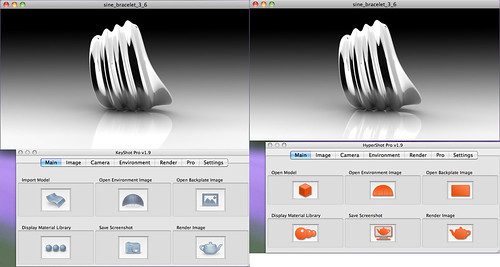
I've uploaded my initial experiments to Flickr for comparison.
These images are one of my old .bip files in Hypershot.
These images are the exact same file in Keyshot.

Bunkspeed, I'm still looking forward to seeing what you have to offer as well. I like at least the potential of HyperMove; even if I've been a little frustrated with the bugs and idiosyncrasies. There is certainly room for any software that makes the designer's job easier. I hope to have our students using both ASAP; I'll let them help us figure which (or possibly both if the $ is right) we will go with in the Fall.

Sunday, January 17, 2010


I could only be more psyched about American cars if I were teleported back for the 1967 unveiling of the Camaro. Or, maybe, if GM pulled a Corvette out of its hat fueled solely by the hot, vaporized hormones of its driver. That would solve the climate crisis - and absorb/leverage some otherwise unspent energy.


Liz and I hit Cobo Hall today to check out the 2010 North American International Auto Show. We missed the big unveilings and, luckily, the crowds. I felt like a kid again. Not in an acne way, but in a way that made me feel a rush of energy and obsession for something sexy and impractical. I love cars. New cars, old cars, fast cars...OK, not slow cars, or most of the really tiny cars. But a car is pretty much the every-thing.

Here are a few of the things we saw:


Wednesday, September 16, 2009

dElitist Software

Screen shot 2009-09-16 at 10.59.47 PM
Hypershot 2010 in fullscreen mode with some quick SmoothTeddy models

Today, one of our students was talking about the future in Thesis class. He was contemplating a body of work that embraces the rapid changes in the world; but was unsure about taking on an optimistic point of view because he really didn't believe it. Well, in at least one respect, I am looking forward to the future. Not a future of increasingly sophisticated and complicated systems, where only those of us who are willing and able to memorize and control complicated workflows can create. I am looking forward to the generations of software and hardware that we can understand by playing with them, where there are results between technical success and failure. Naked edges in NURBS, incompatible filetypes, out of gamut colors, drivers that won't install...I think this stuff is dying. Designers are increasingly capable of giving us studio tools that barely even need to be taught as technical subjects in college courses. What's my evidence? For now, Hypershot.

When I started 3D modeling, less than 10 years ago, the modeling process was complicated enough - generating anything approaching photo-realistic renderings was pretty much rocket science to me. 3D Studio Max has about 100 dialog boxes with sub boxes within sub boxes - it's super powerful and too difficult to learn and has way more features than a designer would EVER use. Flamingo was awesome and fairly straight forward - but was still more difficult to setup than a photography studio to take pictures of physical work. When an auto designer at GM introduced me to Hypershot my first words were "this is how rendering should work." I took existing data that I had created with significant labor, and used Hypershot's virtual camera to take pictures of it in views and materials that were realistic and compelling. This software DSLR is faster, has more flexibility, and can shoot in dynamic points of view that my Olympus Evolt 500 could get into only if I fitted it with a robotic tripod arm and a lens with infinite depth of field. And I was realistically rendering within minutes of getting the model into rough shape. I could confidently 'digitally prototype' my design well before the piece was "watertight;" making decisions about whether or not something was right before I even finished the form, before I hit "print" on any of our 3D printers, before I went through the 20 hours of finishing one of my castings.


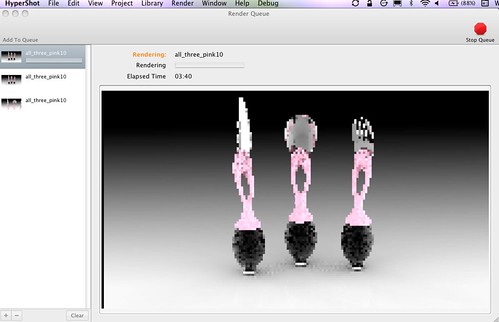
The new render queue in Hypershot '10, visual, simple, it persists even if you have to close it out, crashes etc.

The key advantages, to me, of Hypershot include: it is always rendering in real time. As soon as you move your viewport, it starts casting shadows, reflections, etc. There are NO LIGHTS. You get dynamic light from an environment map which not only illuminates, but provides the reflections to accentuate your form (and you switch between them at will to change the mood of the image). There is no visible horizon to worry about accidentally seeing in the frame. If you are looking, like me, for some kind of neutral infinity background, it uses any .jpg or .tiff image as a 'backplate' behind your rendering to cover the environment/ground behind the model. And there are few complicated choices to make in the selection of materials and output etc. You drag and drop, slide qualities up and down, choose between few standard formats for the image.


Recently I started beta testing the '10 version of Hypershot. And its ease of use, professional power, visual simplicity, and available customization is an example I wish more companies would follow. It has gotten more sophisticated, there are more options. But they were designed in such a way that they are fairly intuitive, they don't obscure the process of image making - they clearly facilitate it. When I demo this software for my students tomorrow, it will be with an awareness that my traditional role as vessel of technical knowledge is fast becoming obsolete. I am looking forward to this future - when I can concentrate on helping them with their bigger problems; like becoming effective designers - not mechanics. My role as chief know it all is all but over, right when I was about to run out of steam staying two steps ahead of them on the latest version of software...

Hypershot '10 is the '64 Mustang, Chester Carlson's photocopier, the first Macintosh. One of those things you didn't know you needed or wanted until someone put this beautiful, simple, game changing widget in front of you and said "hello," I love you. Now, if we could just work on getting the price down, you could all see what I mean.

My experiments with Hypershot (2)010 so far can be found here. Many more images from my students and I using Hypershot 1.5-1.9 can be found here.

Thursday, August 20, 2009

Degenerate


When I started exploring fluid modeling a lot of things excited me about it; some of which I've been following up on, and many more which will take me years of work to understand. It was wet, shapely, ephemeral, controllable and chaotic, and deeper than any set of technologies I'd yet plunged into.

I have been playing with the "fill object" emitter within Realflow since I began learning the software - giving my scenes bodies of fluid into which I can drip objects or other emitters in order to generate dynamic "spatter." But it can be used on an imported element as well; in my case one of the very fluid orphans I've been creating over the past few months. That filled object can then be under the influence of various forces and other objects, and can change over time - degenerating new primary and secondary elements. I can take an otherwise and relatively smooth object and give it bubos, force those nodes to break off or homogenise into a puddle. This is my first thought (flickr images)...

spatter_spatter_4spatter_spatter_6.39spatter_spatter_6.41spatter_spatter_6.37
(some thumbnails from flickr)

I'm not really ready to go full Terminator 2 on it; but it does seem like a reasonable way to start layering all these data sets together into more "maniacal" forms. Whether or not they'll have legs...who knows?


Prototypes being rendered on a Dimension 1200SST 3D printer

Monday, August 17, 2009

Beam

P1013749 1

I've been spending a lot of time with the thousands of fluid meshes I've orphaned over the past few months. And I've finally gotten around to one of the first uses for which they were created; composing and constructing objects from them without having predesigned the object in advance.

I am going to be a part of a show called "Re/Thinking Design for Consumption" at the Scarab Club in Detroit next month - and I wanted to be able to show some new jewelry beyond my spatter pins.

Over the past few days I turned a number of the elements that have been rendered in red and pink ABS by our FDM machine into a new necklace called Beam. The cord is black silicone. No clasp.

More images of this piece can be found here.

It can be seen in person (along with other recent work) Sept 2 - October 18th at
Re/Thinking Design for Consumption
curated by Christine Bossler and Erica Bartels
The Scarab Club
217 Farnsworth St
Detroit, MI 48202-4018
(313) 831-1250